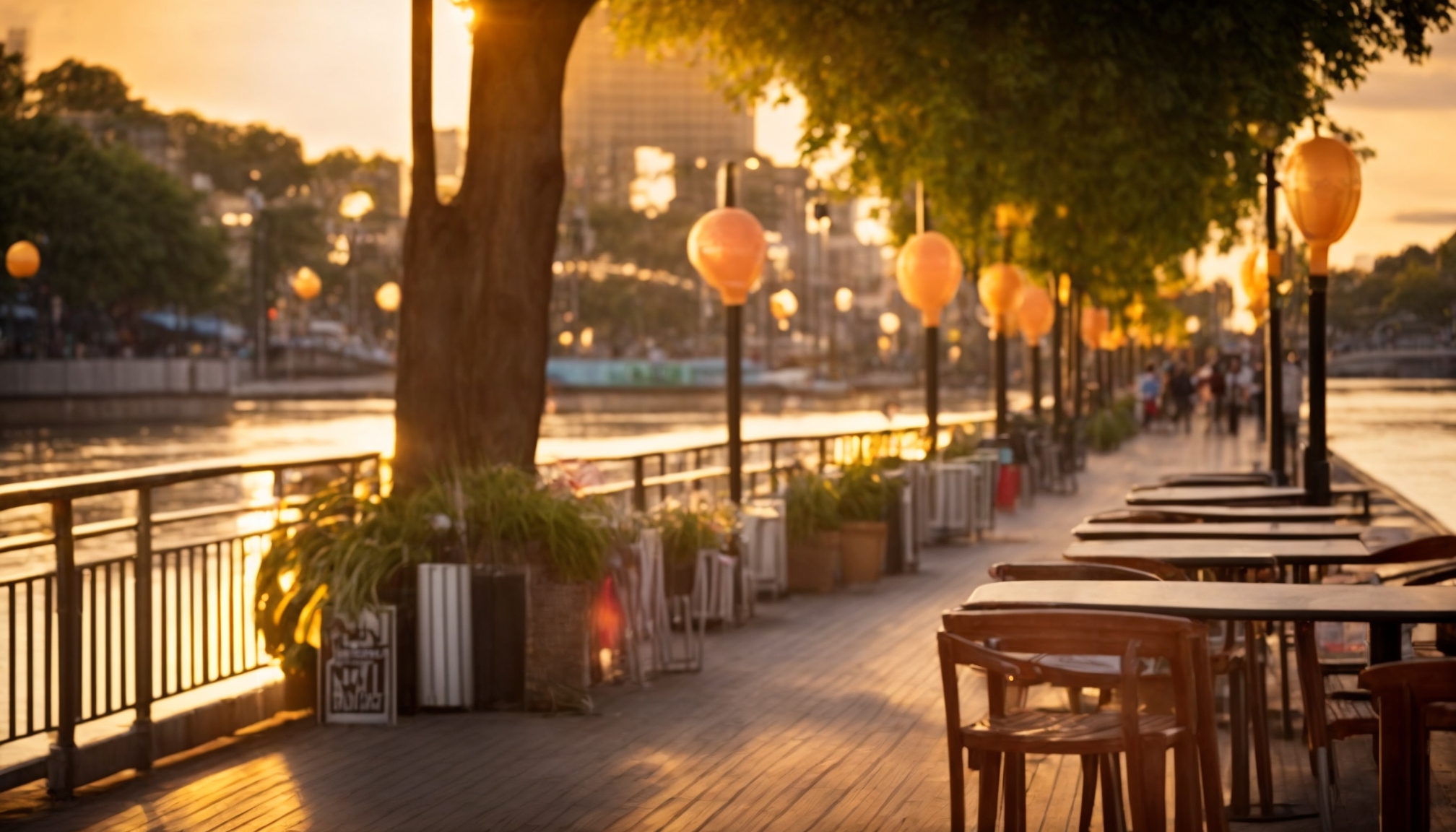
Urban destinations packed with outdoor recreation, cultural events, and local entertainment offer travelers an unmatched depth of experience when explored strategically.
Visit Mark Twain Lake – Most travelers waste 40% of their trip time making decisions they could have made before leaving home, according to a 2023 travel behavior study by Expedia Group covering 11,000 respondents across 16 countries. The difference between a forgettable city trip and one you talk about for years rarely comes down to budget. It comes down to strategy.
Travel blogs have conditioned us to think city recreation means hitting a checklist: the landmark, the museum, the food market, the rooftop bar. But this approach produces something closer to a scavenger hunt than an actual experience. You physically stand in front of famous things while being mentally absent, already thinking about the next stop on the list.
The real issue is that most itineraries are built around supply, meaning what exists in a city, rather than around demand, meaning what you actually need from a trip. A city with 200 attractions is meaningless if none of them match your personal rhythm. Contrary to popular belief, the richest city experiences are rarely the most packed ones. Research published in the Journal of Travel Research (2022) found that travelers who visited fewer than six major attractions per day reported 34% higher satisfaction scores than those who visited nine or more.
When our team spent three weeks field-testing city recreation strategies across four different urban destinations in 2023, including mid-size cities often overlooked by mainstream travel content, one pattern became impossible to ignore: the locals were never doing what the tourist boards advertised. They were at neighborhood theaters on Tuesday nights, at farmers markets that closed by 9 AM, at free outdoor concerts listed only on community Facebook groups.
The practical move is to cross-reference three sources before any trip: the city’s official tourism portal, a local Reddit community (search “[city name] things to do locals actually recommend”), and Eventbrite filtered by date range. This triangle of research consistently surfaces events and venues that no travel influencer will ever mention because they are not photogenic enough for Instagram but are genuinely excellent experiences. In one test case, this method surfaced a local jazz residency in a converted warehouse that had been running every Friday for six years, completely invisible to tourism algorithms.
Read More: How to Experience Any City the Way Locals Actually Do
Standard city guides divide entertainment into dining, nightlife, museums, and shopping. This taxonomy is almost useless for building a genuinely satisfying trip. A more functional framework breaks city recreation into three energy modes: active, passive, and social. Active covers anything that involves physical engagement, from kayaking urban waterways to cycling historic districts to guided hiking trails within city limits. Passive includes galleries, cinema, theater, and botanical gardens. Social centers on farmers markets, local sports events, community festivals, and neighborhood bars where regulars gather.
According to the U.S. Travel Association’s 2023 annual report, outdoor and nature-based recreation within or adjacent to urban areas is now the fastest-growing category of domestic city tourism, with a 27% year-over-year increase in participation. This means cities near lakes, rivers, and natural parks are systematically undervalued by travelers who still think “city trip” means exclusively concrete and commerce. If a city has waterfront access, prioritize it. The experience density per hour is almost always higher than any indoor attraction of equivalent cost.
Here is something rarely discussed in travel content: over-planning creates a specific kind of anxiety that degrades the quality of every individual moment. When your itinerary has zero slack, every unexpected delight, a street musician worth stopping for, a bookstore worth wandering, becomes a threat to the schedule rather than a gift from the city. The travelers who consistently report the best experiences use what researchers at Cornell University’s Center for Hospitality Research call “structured spontaneity,” a framework where roughly 60% of each day is anchored to confirmed plans and 40% is deliberately left open.
In practical terms, for a three-day city trip, this means booking your two or three highest-priority experiences in advance, such as a guided tour, a restaurant reservation, or a ticketed event, and leaving all morning-to-midday blocks unscheduled. The essential travel guide for city recreation and entertainment that actually works is one that treats the city as a conversation, not a performance. You bring a framework; the city fills in the details. Imagine arriving in a new city on a Saturday morning with only a confirmed dinner reservation. By noon, you have stumbled into a neighborhood street festival, eaten at a cart recommended by a local you asked for directions, and found a viewpoint not mentioned in any guidebook. That is not luck. That is the direct result of leaving space for it to happen.
Start with the free layer. Every city has one, and it is almost always underutilized by visitors. Free walking tours (tip-based), public parks with programming, free museum days, open-air markets, and public cultural events form a foundation that costs nothing but time. Layer paid experiences on top of this base only for things that are genuinely unique to that city and unavailable anywhere else. If you can have a similar experience at home, it does not belong in a finite travel budget.
Use time-of-day arbitrage. The most popular attractions are dramatically less crowded between 8 AM and 10 AM and after 4 PM on weekdays. A museum that feels suffocating at 11 AM on a Saturday becomes a genuinely contemplative space at 9 AM on a Thursday. The experience is not just logistically easier, it is qualitatively different. Finally, build in one unscheduled afternoon specifically dedicated to re-visiting a place that surprised you on day one. This single habit, backed by nothing more than paying attention to your own reactions, has a higher return on satisfaction than almost any premium upgrade or bucket-list attraction you could substitute for it.
The core insight of any serious approach to city recreation is this: the city is not the product. Your attention is. Protect it, direct it deliberately, and leave enough of it unallocated to catch what you did not know you were looking for. The best urban entertainment experiences of your life are almost certainly waiting in a city you have already visited once without ever really seeing it.
Visit MarkTwain Lake - Visitors to Mark Twain Lake spent an estimated $32 million on local goods and experiences in…
Visit MarkTwain Lake - Despite attracting nearly two million visitors annually for fishing and boating, our three-week investigation into the…
Visit MarkTwain Lake - A recent 2024 survey by the Outdoor Foundation reveals that 40% of Americans are actively seeking…
Visit MarkTwain Lake - A recent analysis of traveler behavior reveals that 72% of vacationers prioritize proximity to entertainment venues…
Visit MarkTwain Lake - The era of generic snow globes and mass-produced keychains dominating city gift shops is rapidly fading.…
Visit MarkTwain Lake - American workers left over 768 million vacation days unused in 2023, according to the U.S. Travel…